
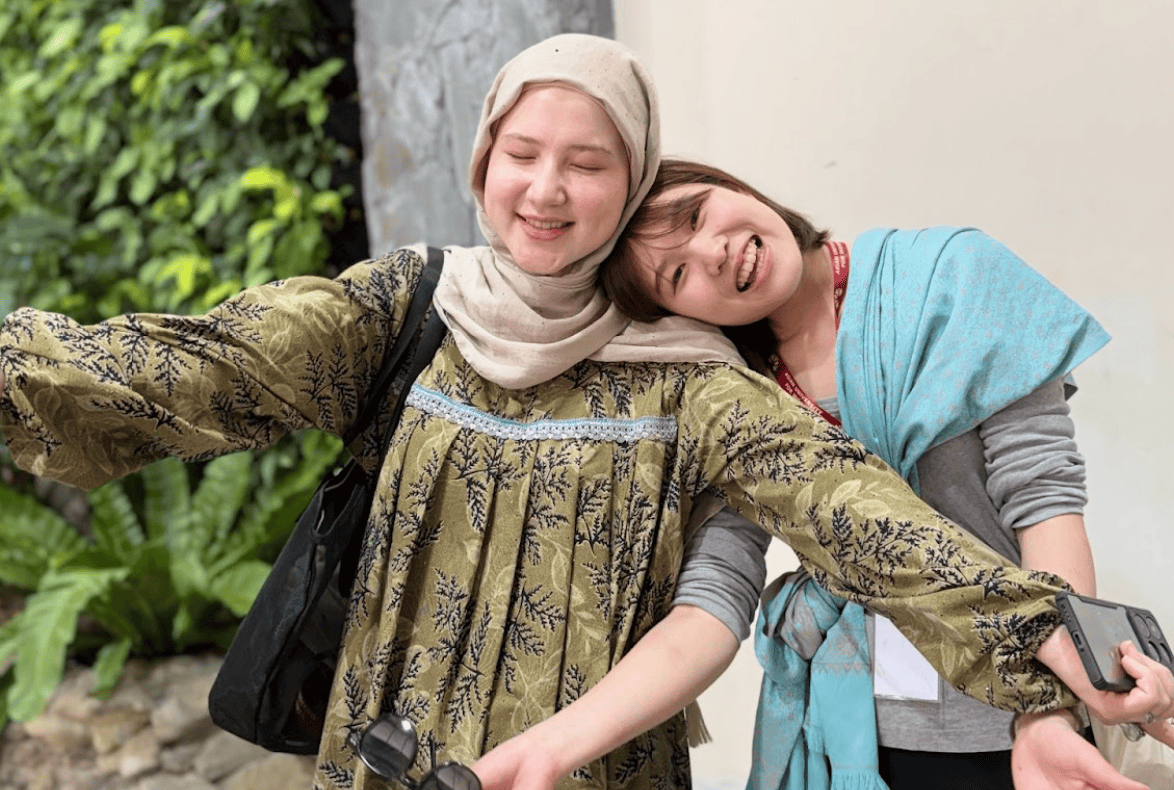
I started working as an intern at Gojo, drawn by its work in promoting financial inclusion and its impact on women’s empowerment. This month, through a separate opportunity, I joined a two-week exchange programme at a women’s university in Bangladesh. The university was established to provide higher education opportunities not only to women in Bangladesh, but also to those from socially disadvantaged backgrounds across Asia and the Middle East. During this programme, I met a friend whose story made me reflect deeply on the power of women’s economic independence and the potential of education. In this blog, I would like to share her story.
Narges is a 20-year-old woman from Afghanistan. Due to the Taliban regime, women are not allowed to attend university in her home country, so she left her family and came to Bangladesh to continue her education, even under life-threatening circumstances.
What she shared with me was the story of her family. Her mother married at a very young age and has since been financially dependent on her husband, with no income of her own. In such relationships, the balance of power is often heavily skewed—if a wife does not comply, her access to money can be restricted, and even in situations of violence, leaving or speaking up becomes extremely difficult. For her mother, this was simply “normal.”
However, Narges’ sisters chose a different path. Both of them were married at a very young age—at 14 and 15—and were themselves victims of child marriage. Despite the significant social expectations and challenges that came with it, they made the decision to continue their education. Through learning, they came to understand the importance of financial independence and chose to keep working even after marriage, despite not being understood at first. By earning their own income, they gained the ability to support themselves and speak up when needed. Financial independence, in this sense, is not only about earning money—it is about having the power to make choices in one’s own life.
For Narges, her sisters became role models. Watching them, she realised that women also have power, and she studied hard from a young age, eventually deciding to pursue higher education even if it meant leaving her country. This influence gradually transformed her entire family—her mother, who once accepted dependency as natural, now places the highest importance on her daughters’ education and strongly believes in women’s economic independence. One woman’s choice can change the values of a family and expand the possibilities for the next generation. Listening to this story made me reflect again on the meaning of financial inclusion, which Gojo works to promote. It is not simply about access to money, but about enabling those in vulnerable positions, especially women, to gain the power to choose their own lives. And this change does not end with one individual. When one woman becomes independent, the impact spreads to her family, friends, and community. As more women like Narges’ sisters emerge, values begin to shift, and the accumulation of these micro-level changes leads to broader change.
Through this experience, I truly felt that chain of change. At the same time, I was deeply struck by the power of sharing stories. Narges told me she feels both responsibility and pride in telling her story and her sisters’ story, because they may inspire other women. As an intern at Gojo, being exposed to these real voices has helped me understand the meaning of financial inclusion in a much more tangible way. Small changes begin with one person’s choice, and those changes continue to reach others. I believe it is this accumulation that ultimately has the power to change society.
Narges (center) with friends after sharing her story in an International Women’s Day event / Aki Hoshino
Aki Hoshino
Corporate Planning Intern