
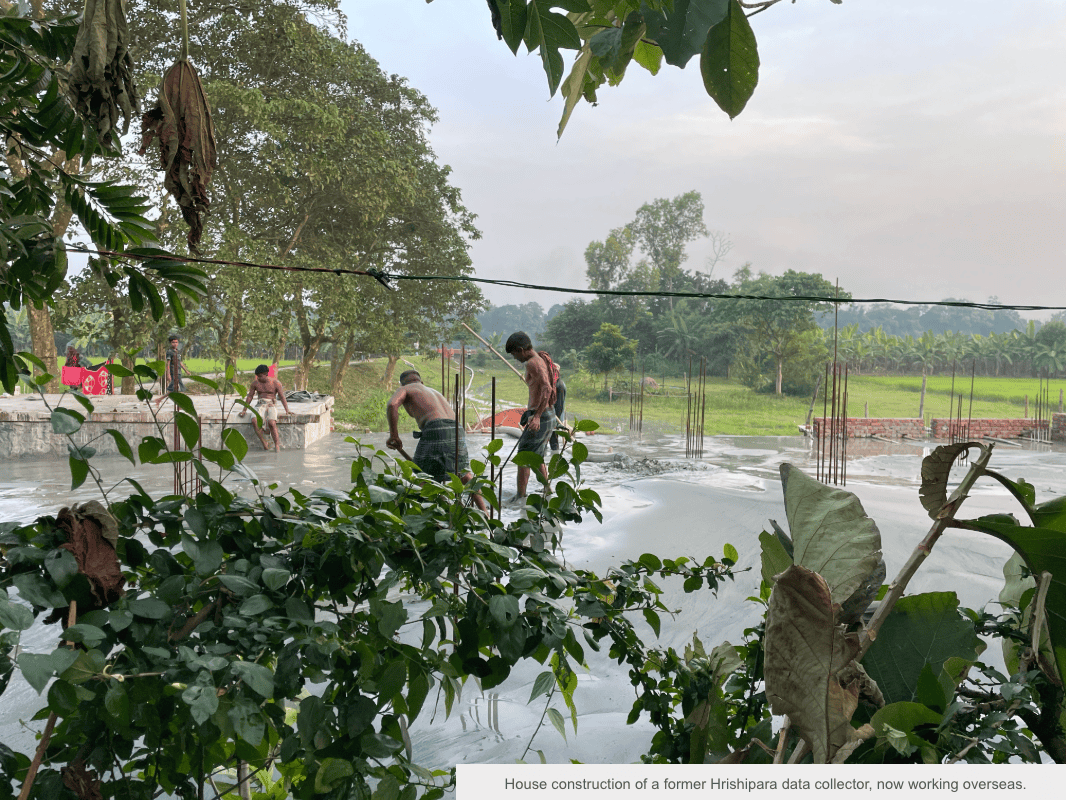
For the families of migrant workers in developing economies, an overseas remittance is far more than a monthly transaction; it represents a hard-fought lifeline to secure a foothold toward a stable future. Households take on immense economic risks by clearing out family savings, borrowing heavily, and mortgaging property to cover recruitment costs.
This blog post focuses on the most recent 6 months of data (January-June 2026) from the Hrishipara Diaries in Bangladesh, tracking 60 low-income households. Families in Hrishipara regularly send members overseas to seek opportunities in the Middle East (Dubai, Oman, Qatar, and Saudi Arabia) and Southeast Asia (Malaysia, Singapore, and Cambodia), so our diary data offers a look into the financial lives of migrant workers and their support for families back home.
Delivery Channel: Mobile Finance Dominates
28% of the 60 diarist households recorded at least one overseas remittance over these six months. Collectively, these families received Bangladeshi Taka (“BDT”) 1.97 million (USD 16 thousand)* across 162 remittance transactions.
When we think of international money transfers, we might picture traditional banks or informal cash transfer modes. However, for these very low-income households, the data reveals a modern reality.
*FX rate of the Central Bank of Bangladesh as of the end of June 2026
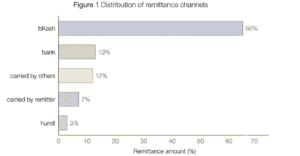
Regulated mobile financial services (MFS) have revolutionized money transfer in the past decade. ‘bKash’ (one of the leading MFS in Bangladesh) is by far the dominant platform among our diarists, processing BDT 1.3 million (USD 11 thousand) of their remittances over the past 6 months, with 82% of receiving households using this mobile digital tool. In contrast, traditional bank transfers accounted for BDT 250,000, serving 24% of the households. Physical carriage, either by the returning remitter or friends/relatives, was used by 52% of households, and the ‘hundi’ (an informal, trust‑based, money transfer network that uses brokers to deliver money anonymously outside the formal banking services) mode accounted for just 3% of the total value.
Cash Flows: Frequency and Festivals
Remitters consider both their families’ household needs and cultural obligations when they make their transfers.
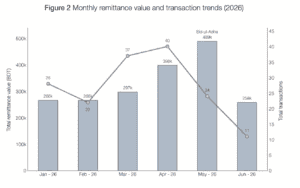
Small but Frequent vs Occasional but Large: Some families rely on a continuous stream of micro-transfers. For instance, Diarist 32 recorded 73 separate, small transfers sent by two sons working overseas and managed locally by their daughters-in-law over the six months. Conversely, others receive infrequent but large lump sums ranging from BDT 10,000 to BDT 100,000 (USD 81 to USD 810) to handle major household expenditures.
The Festival Surge: Remittances surge in alignment with religious and social calendars. The data shows a spike in May 2026, culminating in a peak of BDT 489,000 (USD 3,961) sent just before the Eid festival. These funds are directed toward family feasts, clothing purchases, and religious rituals.
Remittance Spending: Savings Reinvestment
A detailed analysis shows that families tend not to spend on just one major category but distribute lump sums across multiple areas. Below are the top spending patterns for remittance income among our diarists:
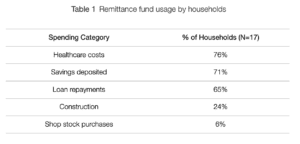
Apart from a surge in food costs for almost 100% of households, nearly 71% deposited funds into formal savings and 76% covered healthcare bills. Over 65% immediately repaid loans to MFIs, co-operatives, and other informal lenders (some debts incurred for the migrant's initial visa or travel), indicating that debt clearance is of high priority. Furthermore, 24% of households used remittances for home renovations and 6% for micro-business investments, such as stock purchases.
Impact of Geopolitics
While migration offers a pathway to upward economic mobility, it also increases a household’s exposure to macroeconomic and geopolitical shocks. The escalation of the conflict in Iran in the first half of 2026, leading to rising fuel import costs, intensified domestic economic pressures, pushing the Consumer Price Index (CPI) inflation rate to a high of 9.4% in May. Increasing costs of food, electricity, fuel, and cooking gas squeezed families' purchasing power, even when remittances are received.
For some households, the global pressures directly translate into a crisis. For example, Diarist 20 steadily received funds from her son in Saudi Arabia totaling BDT 145,000 (USD 1,174) between January and April 2026. However, as the Iran conflict heightened, his employer could no longer fund his work permit. To keep him employed, his family back home had to sell farm assets, take out an informal loan, and rely on gifts from relatives to pay for the permit. Another household saw their son return prematurely from Cambodia simply because "there is no work."
Conclusion
It is a common belief that remittance flows among low-income migrant households occur mainly through informal and untracked channels (like ‘hundi’). Still, the financial diaries analysis reveals that a vast majority (66%) of funds are received through regulated financial platforms like bKash. This adoption of digital services has been driven notably by the Government of Bangladesh's cash incentive on formal inward remittances, which was introduced in 2019 and increased to 2.5% in 2022.
Furthermore, the behavioral pattern of these households is cultural and event-driven, as seen in the surge in remittances in May, coinciding with the Eid festivities. These overseas remittances not only uplift a single family but also have a broader, indirect impact on extended families, local communities, and financial institutions as funds are directed into savings, loan repayments, small business and self-employment activities. Given this digital adoption, predictable surge patterns, and vulnerability to geopolitical shocks, how can formal financial providers design savings or insurance products that align with these seasonal remittance cycles?
Mercyline Manoj
Researcher-in-Residence